
Most local SEO advice treats every local business the same: claim your Google Business Profile, gather reviews, build citations, and you will appear in the map pack. That advice is not wrong, but it assumes the search results themselves look the same from one sector to the next. They do not.
A plumber, a dentist, a solicitor and a car mechanic all serve customers locally, yet the page Google returns for each is built very differently. In some sectors the local pack dominates the screen. In others it is pushed down by an AI Overview or buried under paid ads costing several pounds a click. We analysed 979 genuine local-intent searches across 11 UK service sectors to measure exactly how local results are built, and where the real opportunities and obstacles lie.
For the fundamentals, see our ultimate guide to SEO for UK businesses.
We used the Ahrefs API to pull every keyword associated with 11 UK service sectors: skilled trades (plumbing, electrical, roofing, plastering and bricklaying), automotive, hairdressing, dentistry, estate agency, accountancy and legal services. After filtering out non-local noise such as jobs, salaries, training, software and brand terms, we analysed 979 genuine local-intent keywords from the United Kingdom database. For each one we recorded its search volume, keyword difficulty, cost-per-click and the SERP features Google displays, then measured how often the local pack, AI Overviews and paid ads appear in each sector. All figures reflect a June 2026 snapshot; local search results vary by searcher location and change over time.
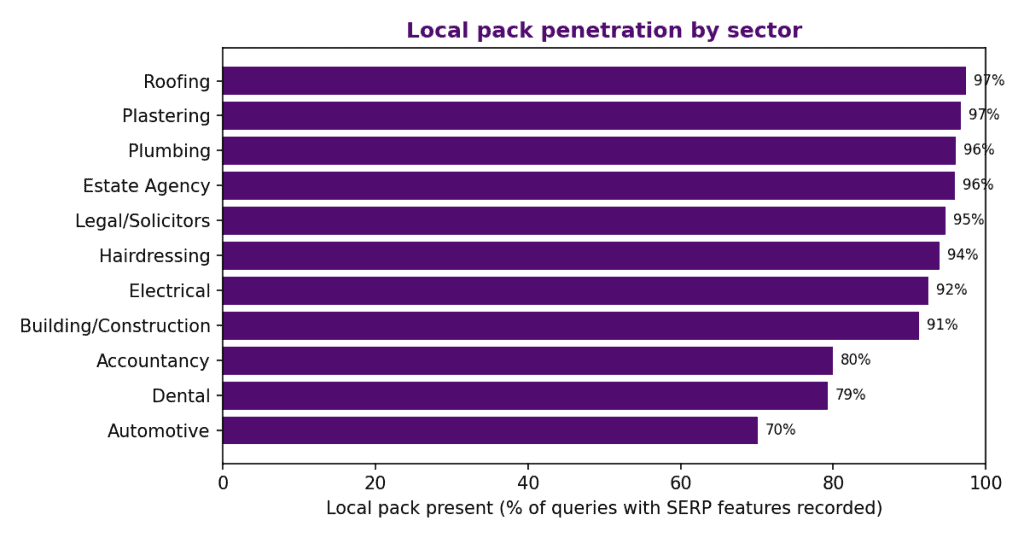
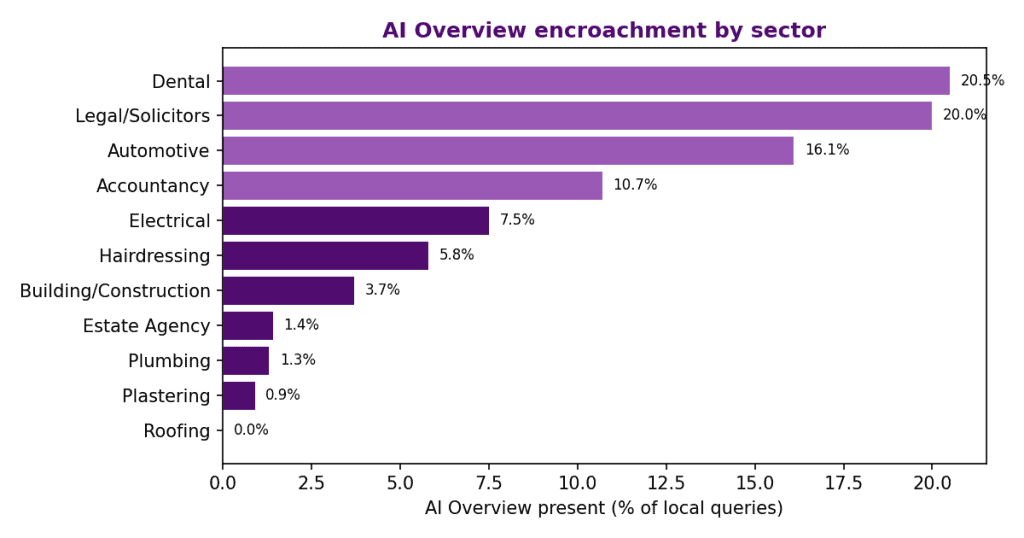
The full picture across all eleven sectors. Local pack and AI Overview percentages are shares of local-intent queries; paid percentage is the share showing a paid_top or paid_bottom placement; KD and CPC are medians.
| Sector | n | Local pack % | AI Overview % | Paid % | Median KD | Median CPC (GBP) |
|---|---|---|---|---|---|---|
| Plumbing | 155 | 96.1 | 1.3 | 36.1 | 12 | 350 |
| Electrical | 107 | 92.5 | 7.5 | 35.5 | 9 | 200 |
| Roofing | 170 | 97.4 | 0.0 | 17.6 | 12.5 | 300 |
| Plastering | 113 | 96.8 | 0.9 | 10.6 | 3 | 100 |
| Building/Construction | 27 | 91.3 | 3.7 | 40.7 | 0 | 70 |
| Automotive | 87 | 70.1 | 16.1 | 39.1 | 2 | 80 |
| Hairdressing | 86 | 94.0 | 5.8 | 9.3 | 22 | 40 |
| Dental | 112 | 79.3 | 20.5 | 40.2 | 26 | 110 |
| Estate Agency | 74 | 96.0 | 1.4 | 18.9 | 24.5 | 130 |
| Accountancy | 28 | 80.0 | 10.7 | 39.3 | 26 | 350 |
| Legal/Solicitors | 20 | 94.7 | 20.0 | 65.0 | 32.5 | 350 |
Percentages show how often each feature appears in a sector’s local search results. KD = keyword difficulty; CPC = cost-per-click. n = local-intent keywords analysed.
Grouping the eleven sectors into six commercial bands makes the structural differences clear. The trades behave as a coherent block. Healthcare, professional services and automotive each break from that pattern in a different way.
| Band | n | Local pack % | AI Overview % | Paid % | KD | CPC |
|---|---|---|---|---|---|---|
| Trades (plumber, electrician, roofer, plasterer, bricklayer) | 572 | 95.6 | 2.1 | 25.7 | 9 | 200 |
| Personal care (hairdresser) | 86 | 94.0 | 5.8 | 9.3 | 22 | 40 |
| Property (estate agent) | 74 | 96.0 | 1.4 | 18.9 | 24.5 | 130 |
| Professional services (accountant, solicitor) | 48 | 86.4 | 14.6 | 50.0 | 30 | 350 |
| Healthcare (dentist) | 112 | 79.3 | 20.5 | 40.2 | 26 | 110 |
| Automotive (mechanic) | 87 | 70.1 | 16.1 | 39.1 | 2 | 80 |
KD and CPC shown as band medians. CPC in GBP.

The scatter separates two distinct competitive realities. The trades and automotive cluster in the low-difficulty band: genuinely winnable on organic and local-pack optimisation. Professional services sit high on both axes (hard and expensive). Dental and estate agency are difficult but not especially costly per click, while hairdressing is moderately difficult but the cheapest to advertise in.
Plumbing, electrical, roofing, plastering and bricklaying form the most consistent band in the study. The local pack appears on 95.6% of local-intent queries where SERP composition is known, AI Overviews are almost absent (2.1%), and median keyword difficulty is just 9. Plumbing shows the highest CPC of the trades (median 350 GBP) reflecting genuine commercial heat, but the route to visibility remains overwhelmingly the map pack and organic listings rather than paid.
The practical implication for a trades business is that Google Business Profile optimisation, local relevance and reviews still do the heavy lifting. The keywords are not hard; the work is being present and credible in the pack.
Dentistry diverges sharply from the trades. An AI Overview appears on 20.5% of local dental queries, the highest of any sector and marginally ahead of solicitors, and many “near me” and city searches surface knowledge panels and NHS information rather than, or alongside, the local pack. The pack is present on 79.3% of queries, well below the trades, and median difficulty is the joint-highest at 26.
For a dental practice this means the top of the result is increasingly occupied by answers Google generates itself, particularly around NHS availability, costs and emergency care. Ranking in the pack remains valuable but captures a smaller share of the visible page than it does for a plumber.
Accountants and solicitors share a profile of heavy brand and informational pollution at the seed level and, once cleaned, a thin but high-value local set. Half of their local queries carry paid placements and median CPC reaches 350 GBP, by far the most expensive band. Legal queries also show 20% AI Overview presence and the single highest median difficulty (32.5).
The thin organic yield is itself the story: much of the visible competition in these sectors is paid, and the informational layer (“what does a solicitor do”, “how much does an accountant cost”) is large relative to genuine hire intent. Competing organically is possible but slow; the paid market is where incumbents concentrate spend.
Estate agency and hairdressing both show very high local pack presence (96% and 94%) with low AI Overview encroachment. They differ on cost and difficulty: estate agency queries are harder (median KD 24.5) and moderately priced, while hairdressing is the cheapest sector to advertise in (median CPC 40 GBP) at moderate difficulty. Both are classic map-pack sectors where local optimisation pays off directly.
Car mechanic search is dominated by “mobile mechanic” intent and has one of the lowest median difficulties in the study (2). Yet it shows meaningful AI Overview presence (16.1%) and paid saturation (39.1%), a profile shaped by national booking platforms and breakdown brands bidding on local queries. The opportunity for an independent garage is real because difficulty is low, but the visible result is more contested by non-local players than the trades are.
The divide between sectors is not random. It tracks how Google judges the risk and complexity of each query. Trades sit in the safest category: when someone searches for a plumber, the intent is unambiguous and local, the stakes are low, and a list of nearby providers answers the need perfectly. Google has little reason to insert an AI summary or surface national information, so the local pack does the job and dominates the result.
Healthcare behaves differently because dental queries carry health and cost implications, and a large public-sector layer. Searches around NHS availability, treatment costs and emergency care invite the kind of summarised answer that AI Overviews and knowledge panels are built to provide, which is why dentistry shows the heaviest AI encroachment in the study. Professional services are shaped by economics rather than information: a single client in law or accountancy can be worth thousands of pounds, so firms bid aggressively, and paid ads crowd the result. That commercial value is exactly what pushes cost-per-click to the top of the table.
Automotive is the most contested of all because it sits between two worlds. The intent is local, but national booking platforms and breakdown brands have built their entire model around capturing that local demand, so independent garages compete for visibility against far larger players even though the keywords themselves are easy to rank for.
The clearest trajectory in this data is AI Overview growth. Our guide to what GEO is covers how local businesses get cited in those summaries. Today it is concentrated in sectors with an informational or public-service dimension, dentistry and law most of all, while trades remain almost untouched. The likely direction of travel is that AI Overviews spread outward from these information-rich sectors toward more commercial ones as Google grows more confident in summarising local intent. Businesses in healthcare and professional services should expect the top of their results to become more AI-led, and should invest now in the kind of clear, well-structured, authoritative content that AI systems prefer to cite. This is the heart of answer engine optimisation. Trades and other pack-dominant sectors have more time, but the same principle will reach them eventually.
Local search is not one playing field but several. The local pack remains the centre of gravity for most local-service sectors, and for trades it is almost the whole game. But healthcare, professional services and automotive each break from that pattern in their own way, whether through AI summaries, paid saturation or competition from national platforms.
The practical lesson is that there is no single local SEO strategy. The right move depends on how your sector’s results are actually built, and this study gives local businesses a clear, evidence-based picture of where to focus.

Get practical SEO and digital marketing tips that help your business win more customers from Google - straight to your inbox, no jargon.
By subscribing you agree to receive marketing emails from Studio 36 Digital. Unsubscribe any time. See our Privacy Policy.