
The search engine landscape is going through one of its most turbulent phases in years. Following Google’s first confirmed core update of 2025—which officially completed on 27th March—many site owners expected a period of relative stability in the search results. Instead, volatility returned with a vengeance just days later. From unexpected ranking shifts to unexplained traffic drops, April has already proved to be another anxious month for webmasters and SEO professionals.
This article explores the current search volatility in April 2025, outlines the timeline of changes, and discusses what might be causing continued fluctuations. It also touches on the broader implications for SEO, particularly in light of Google’s AI integration efforts and the proliferation of AI-generated content.
Google began rolling out its March 2025 core update on 5th March, concluding the rollout on 27th March. As with all broad core updates, the goal was to refine how Google’s systems assess content overall. However, the lack of transparency around what exactly changed once again left site owners guessing.
Many websites experienced noticeable ranking adjustments during this period, both positive and negative. Some reported gradual recoveries from previous hits, while others found themselves suffering significant declines in visibility and traffic.
After the update completed, the final days of March saw relative calm. SERP (Search Engine Results Page) monitoring tools like Semrush Sensor, Rank Ranger, and MozCast reflected reduced volatility levels, suggesting that the immediate impact of the core update had settled. Site owners briefly breathed a sigh of relief.
However, any sense of relief was short-lived:
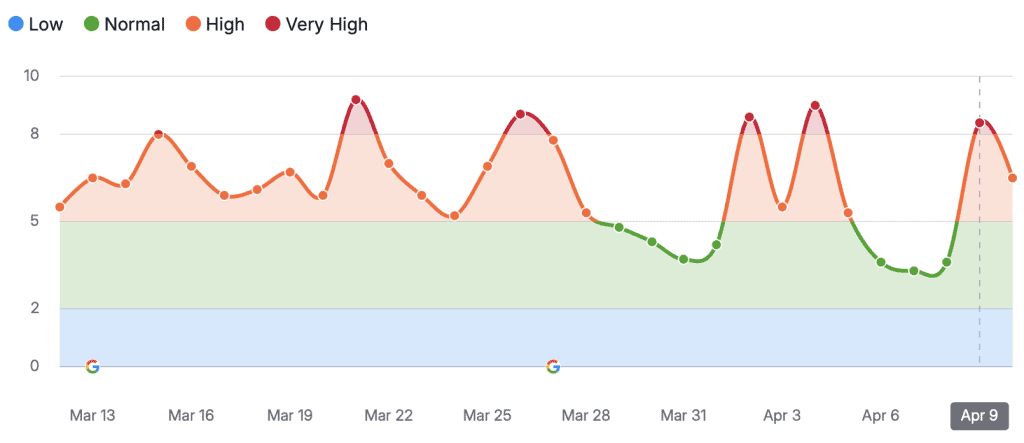
Despite the renewed instability, Google has not announced any further updates or changes since the conclusion of the March core update. It is entirely possible that minor, unconfirmed updates are being deployed—something Google has acknowledged in the past as part of its regular efforts to refine and test its search systems.
However, the lack of communication leaves site owners in the dark, unsure whether they are experiencing residual effects from the March update, the result of unannounced tweaks, or broader algorithmic experimentation.
There are several potential contributing factors behind the ongoing turbulence in search rankings:
Core updates can have lingering effects, as Google’s systems recalibrate and assess how well previously ranked content performs under new signals. Some level of adjustment in the weeks following an update is not unusual, particularly when those updates are substantial.
Google makes hundreds of changes to its algorithms each year, many of which are never announced. These include small refinements to search quality signals, spam detection, indexing behaviour, and more. The search volatility in April may be a sign that such adjustments are being rolled out continuously, even if they don’t meet Google’s threshold for public disclosure.
Google’s increasing push towards integrating AI into its Search Engine Results Pages (SERPs) is reshaping how content is surfaced and evaluated. Features like AI-generated overviews, answer boxes, and predictive search suggestions are likely being tested and refined in real time.
These changes may not just impact the appearance of results but also affect which pages are considered most relevant or authoritative. This could explain why volatility is so widespread and difficult to attribute to any one factor.
One of the most pressing concerns among site owners is the sheer volume of AI-generated content now being published. Tools like ChatGPT, Gemini, and various content automation platforms have made it easier than ever to produce articles at scale.
While Google maintains that helpful, original content will always rank best—regardless of whether it was written by a human or generated by AI—the reality is proving murkier. Many legitimate sites are seeing their content outranked by shallow or duplicated articles, particularly in niche topics.
This phenomenon may be undermining Google’s stated goal of surfacing high-quality content, further fuelling frustration among those investing in original, human-written material.
The current state of SEO feels particularly bleak for many small-to-medium-sized site owners. With core updates and volatility becoming almost constant, it’s becoming increasingly difficult to:
The traditional SEO model of “identify a drop, analyse the cause, and fix the problem” is breaking down. In many cases, site owners are simply at the mercy of algorithmic shifts they can neither predict nor respond to in a timely manner.
There is growing consensus that SEO is, in its current form, the most challenging it has ever been. Despite this, search remains a vital traffic channel for most websites. Abandoning it entirely is not a realistic option.
While there’s no magic solution to ride out algorithmic volatility, there are still sensible strategies to adopt:
Continue focusing on creating content that meets Google’s definition of helpful content. This includes:
Google has reaffirmed the importance of Experience, Expertise, Authoritativeness, and Trustworthiness (E-E-A-T) in content and site quality. Consider:
Reacting too quickly to short-term volatility can make things worse. Wholesale changes in response to every ranking fluctuation may confuse search engines and harm long-term performance. Instead, focus on long-term content quality and technical health.
It’s important to keep an eye on your analytics and rankings—but don’t let daily SERP changes dictate your entire strategy. Use tools like Google Search Console, Ahrefs or Semrush to understand patterns over time rather than obsessing over individual keyword movements.
While search traffic is essential, it’s wise to diversify. Focus on growing email lists, building loyal audiences through social media, improving direct traffic, and collaborating with other brands or influencers.
One recurring theme from the SEO community is the call for more transparency and consistency from Google. While it’s understood that disclosing the full details of every algorithmic factor could be exploited, the sheer volume of unexplained changes is creating an environment of fear, not innovation.
Site owners are not asking for shortcuts to the top of the SERPs. What they want is a clearer, more predictable system where good-faith efforts to create valuable content are rewarded—and where they’re not left second-guessing each minor dip or spike.
A consistent approach to rankings between core updates could provide a much-needed stabiliser. At present, even doing everything “right” does not guarantee any semblance of visibility or growth.
April 2025 is shaping up to be another turbulent chapter in SEO history. Following the March core update’s completion, search volatility spiked again without warning and with no confirmation from Google. While we can speculate about causes—AI integration, minor updates, content quality shifts—the lack of transparency only deepens site owners’ frustration.
Search engine optimisation remains a critical part of digital marketing, but it’s undergoing a profound transformation. For now, the best path forward remains a patient, quality-focused approach that prioritises original content, genuine expertise, and trust-building—while hoping that greater clarity from Google eventually follows.
Until then, site owners must continue to navigate the storm with resilience and realism, knowing they are not alone in their frustration.

Get practical SEO and digital marketing tips that help your business win more customers from Google - straight to your inbox, no jargon.
By subscribing you agree to receive marketing emails from Studio 36 Digital. Unsubscribe any time. See our Privacy Policy.