Blog

SERP Volatility Report: UK, February – March 2025

Last Updated: March 12, 2025

Search Engine Results Pages (SERPs) experienced notable fluctuations in the UK between February and March 2025. This report presents an in-depth analysis of observed keyword ranking movements, providing insights into possible causes and key dates of volatility.

Data Collection & Methodology

To ensure a comprehensive analysis, data was collected across multiple industries, categorised into shopping and service-based sectors. The dataset was derived from organic keyword ranking shifts, tracking changes in estimated traffic, visibility, and position fluctuations. The focus was on capturing ranking movements over time, identifying trends, and assessing the impact of external factors.

For each industry, keyword movements were measured based on gains, losses, and new entries, with comparisons drawn between previous and current organic rankings. Percentage-based volatility calculations were used to normalise data across industries, ensuring a balanced view of ranking trends.

Data was collected from a range of search queries, including high-volume commercial searches, local intent queries, and informational searches, to provide a broad perspective on how different keyword types responded to ranking changes.
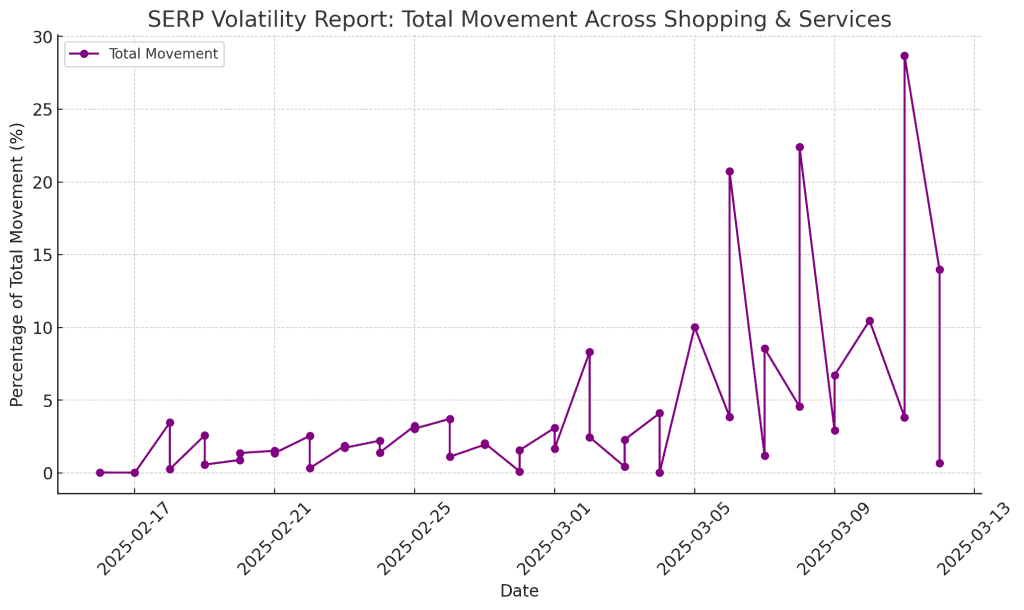
Key Findings: SERP Volatility Trends

SERP Volatility Report Graph: Total Movement Across Shopping & Services

Notable Volatility Dates

Analysis of ranking shifts revealed several key dates where significant SERP movements occurred:

  • February 18, 2025: One of the most significant volatility spikes, particularly in service-related search terms. Affected keywords saw rapid ranking changes, suggesting a potential algorithm tweak that impacted local search results.
  • February 20, 2025: A secondary wave of movement, impacting both shopping and service sectors. This suggests that Google made additional refinements following the initial volatility earlier in the week.
  • March 3-5, 2025: A period of steady ranking fluctuations, affecting a broad range of search terms across multiple industries. The consistent nature of these movements indicates a possible minor algorithm refresh.
  • March 10-12, 2025: Another noticeable shift, with traffic and rankings fluctuating significantly in both industry sectors. This pattern is similar to previous core updates where Google fine-tunes ranking signals over multiple stages.

Shopping Sector Analysis

The shopping sector experienced consistent volatility throughout the period, with notable movements around February 20 and March 10. These shifts may be linked to Google refining its handling of eCommerce-related SERP features, such as product snippets, shopping carousels, and reviews. The fluctuations suggest that Google may have been testing different ways to display product-based search results, impacting visibility for online retailers.

Changes in featured snippets and People Also Ask sections could have also influenced ranking stability. Many eCommerce keywords showed increased competition, suggesting that new or optimised content was able to challenge previously stable rankings. Additionally, fluctuations in rankings for transactional queries indicate that Google may have been re-evaluating how user intent is weighted for commercial searches.

To maintain visibility, businesses in this sector should monitor changes in structured data implementation, optimise for product-rich results, and ensure strong product review integration to adapt to ongoing SERP adjustments. The use of schema markup, improved internal linking structures, and regular content updates will be key strategies in mitigating ranking volatility.

SERP Volatility Report Graph: Shopping Vs. Services

Service Sector Analysis

The service sector saw sharper ranking fluctuations, especially around February 18 and March 5. This suggests potential adjustments to local search ranking factors, particularly for businesses reliant on local pack visibility. These movements may be attributed to changes in Google’s local algorithm, potentially adjusting proximity, relevance, and prominence factors.

Some businesses saw increased volatility in high-intent service keywords, which could indicate stronger weighting given to on-site experience, user engagement signals, and structured service page content. Google’s continued evolution of local ranking signals means businesses should prioritise local SEO strategies, including consistent citation building, reputation management, and location-based content optimisation.

Another possible reason for these fluctuations is changes in review signals and trust factors, which are increasingly influential in local search rankings. The presence of detailed business information, customer reviews, and third-party citations could have been weighted more heavily in Google’s ranking system. To combat instability, businesses should ensure NAP (Name, Address, Phone) consistency across directories, engage in active reputation management, and improve local content relevance.

Theories Behind SERP Volatility

Several potential explanations exist for the ranking fluctuations observed between February and March 2025:

  1. Core Algorithm Update: While no official Google announcement was made, the pattern of ranking shifts aligns with past core updates that impact content quality, E-E-A-T (Experience, Expertise, Authoritativeness, Trustworthiness), and link relevance. This may indicate refinements in how Google evaluates and ranks authoritative content.
  2. Local Search Adjustments: Service-based businesses saw significant fluctuations, hinting at potential changes in local search ranking factors such as proximity weighting and citation trust signals. Local search updates are often unannounced but can have a large impact on businesses that rely on geographical relevance.
  3. SERP Feature Rebalancing: Shopping-related searches may have been affected by changes to product result placements, featured snippets, and People Also Ask (PAA) visibility. Google may be testing different layouts for commercial intent searches to improve user experience and engagement.
  4. Increased Competitor Activity: Competitive search spaces are becoming more dynamic, with new content strategies and link-building efforts influencing rankings. In some cases, businesses that invest heavily in SEO may have overtaken previously established rankings due to stronger content marketing efforts.
  5. AI and Machine Learning Influence: Google’s increasing reliance on machine learning models such as MUM (Multitask Unified Model) and BERT could be affecting how intent and relevance are interpreted, leading to changes in ranking patterns.

What This Means for Businesses and SEO Professionals

Given the volatility observed, businesses should consider the following actions:

  • Monitor SERP feature impact. Identify whether rankings are influenced by Google’s evolving presentation of search results, including featured snippets, local packs, and product carousels. Understanding SERP layout changes can help businesses adjust their strategies accordingly.
  • Strengthen content relevance. In the event of a quality-related algorithm shift, ensuring content remains authoritative, up-to-date, and user-focused will help maintain rankings. Regular updates and adherence to E-E-A-T principles are crucial.
  • Diversify SEO strategies. Relying solely on one ranking factor, such as backlinks or technical SEO, is increasingly risky. A balanced approach incorporating strong on-page SEO, structured data, and entity-based optimisation is essential.
  • Track competitor movements. Given the likelihood of increased competition, businesses should actively monitor competitors’ strategies, adapting their SEO efforts accordingly. Using rank-tracking tools and competitive analysis can provide insights into industry shifts.
  • Enhance Local SEO. Service-based businesses should pay attention to citations, reviews, and Google Business Profile optimisation, as these factors play a growing role in local search visibility.

Conclusion and Ongoing Monitoring

The SERP volatility observed from February to March 2025 suggests a shifting search landscape, potentially influenced by Google algorithm updates, changes to SERP features, and evolving ranking criteria. The key takeaway for businesses and SEO professionals is the importance of constant monitoring and strategic adaptability.

Future analyses will continue tracking industry-specific SERP trends, helping businesses anticipate fluctuations and refine their SEO approaches effectively.

Andrew Witts profile image. Director and SEO specialist at Studio 36 Digital

Andrew Witts

Andrew is the founder of Studio 36 Digital and an advanced SEO specialist with over 10 years of experience helping businesses and brands across the UK improve their online visibility. He holds professional certifications in SEO, including the Ahrefs Certification, and has led data-driven strategies that have significantly increased organic traffic and search engine rankings for clients in a wide range of industries.

Is your website actually getting found?

Get practical SEO and digital marketing tips that help your business win more customers from Google - straight to your inbox, no jargon.

By subscribing you agree to receive marketing emails from Studio 36 Digital. Unsubscribe any time. See our Privacy Policy.

Ideal for:

Medium to large ecommerce businesses looking for a bespoke approach, enhanced brand authority, recognition and visibility for competitive markets.

Ideal for:

Growing small ecommerce stores that need a faster shop and clearer product pages, with ongoing improvements that increase product views, add to carts, and completed checkouts each month.

Ideal for:

SMEs and multi location retailers selling across regions, combining helpful category and product content, improved navigation, and reputation building to increase organic traffic, conversions, and repeat customers each month.

Ideal for:

Ambitious SMEs and national brands in competitive categories, publishing buying guides and product content at scale, earning coverage on trusted sites, and driving monthly growth in high intent traffic, basket value, and revenue.

Ideal for:

Medium to large businesses looking for a bespoke approach, enhanced brand authority, recognition and visibility for competitive markets.

Ideal for:

Growing small businesses that need a smoother, faster site and regular improvements, for example salons, studios, and local retailers, targeting more visibility, calls, and form enquiries.

Ideal for:

SMEs and multi location small businesses competing across towns and regions, for example estate agents and regional service providers, using helpful content to increase rankings, leads, and sales.

Ideal for:

Ambitious SMEs and national brands in competitive markets, for example franchise groups and national service providers, publishing content at scale and earning coverage to drive monthly growth in traffic and revenue.